
Start with the weights, not the sites
The instinct is to open the first site and start reacting. Resist it. Before you score anything, decide what makes a site good for your concept and how much each factor matters. Customer demand, competitive environment, accessibility, lease economics, operational logistics: name the criteria, then weight them.
The best way to set the weights is to back-test against your own portfolio. Which factors most strongly correlate with your top-performing stores? If your best sites all share high weekday traffic and strong co-tenancy but vary widely on household income, then traffic and co-tenancy should carry more weight than demographics. You are encoding your strategy as numbers before a single site is on the table.
Score every site on the same axes
Now apply that one model to all eight candidates. Every site gets scored on the same criteria, quantitative where you can (traffic, income, co-tenancy performance) and qualitative where you must (brand alignment, neighborhood character, lease flexibility). The point is not that judgment disappears. It is that judgment is applied consistently, so the sites are actually comparable instead of each being described in its own language.
Apply a starter template to get your weighted criteria in seconds, tune it to your concept, and score.
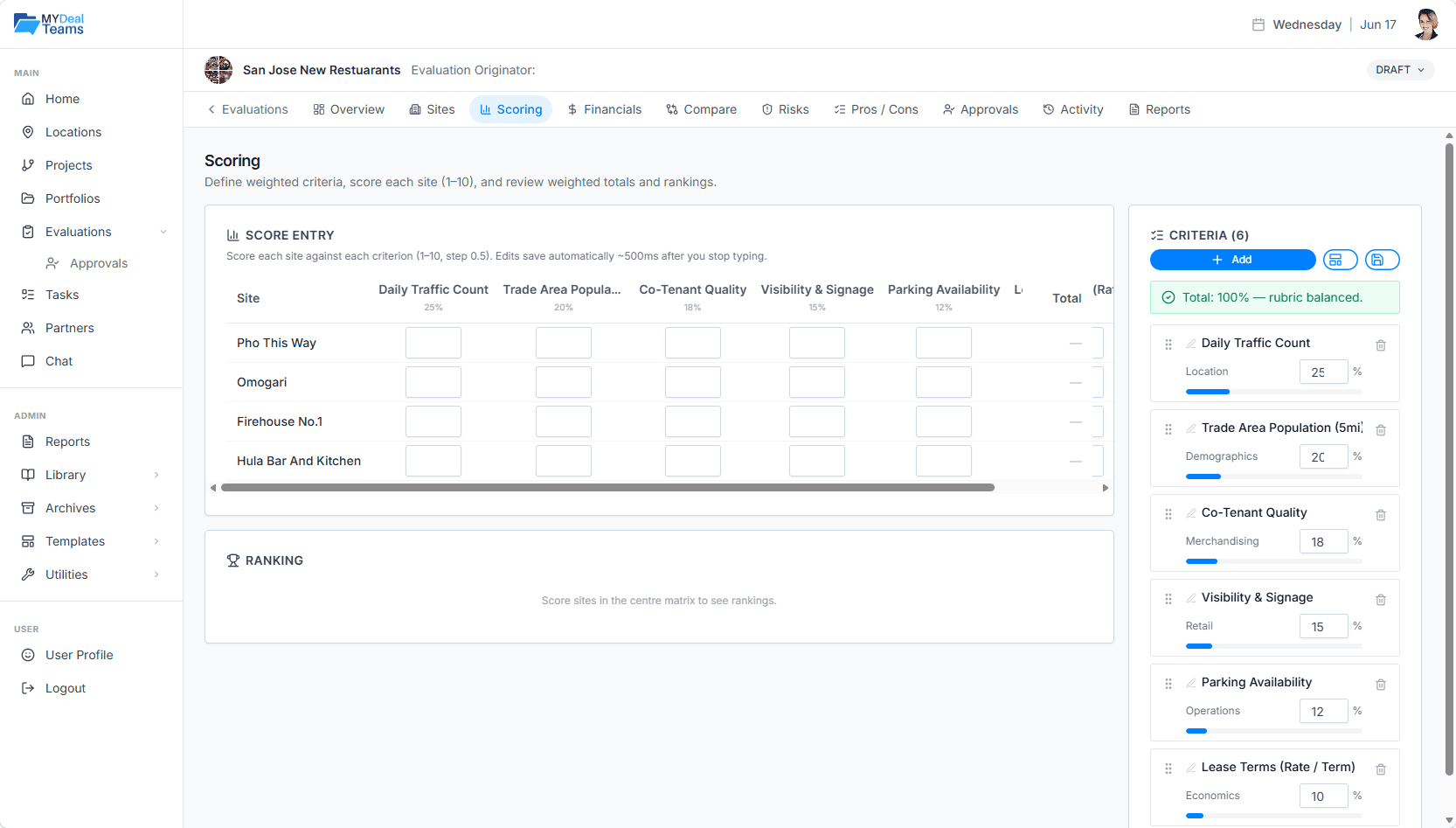
Let the team score, then average
A single scorer is a single point of failure and a single bias. So let the whole team score independently, and average the results. The ranking that comes out is the team's collective judgment, not the opinion of whoever spoke loudest or outranks the others in the room.
And have each scorer attach a justification to the numbers that matter. The score tells you the ranking; the justification tells you why, and it is the justification that answers the committee's questions and survives to next year.
Compare the finalists side by side
Eight sites usually collapse to two or three real contenders fast. Put the finalists side by side and read them across every axis at once: scoring, financials, risk, and the pros and cons. This is where the ranking earns its keep, because the committee's real question is never "is this site good?" It is "why this one and not that one?" A side-by-side answers exactly that question, on the same axes the team already agreed to.
Ten sites in an hour
The payoff of a shared model is speed as much as rigor. When every site is scored against the same criteria on the same record, a committee can evaluate ten sites in an hour instead of spending a full day debating subjective impressions. The method does not slow the team down. It removes the part that always slowed it down: reconciling five spreadsheets to figure out what everyone is even looking at.
That is the whole idea behind the evaluation workbench in MyDealTeams. It is free during Early Access: Community free, Pro $69/month, everything free while we are in Early Access. Nothing to lose, and a deal team to organize.
Source: [GrowthFactor: site selection process guide](https://www.growthfactor.ai/blog-posts/site-selection-process-complete-guide)