
The risk everyone knew and nobody wrote down
Ask anyone who has watched a site underperform, and the story is usually the same. The risk that caused it was known. Someone raised it early, in passing, and it was real. But it never became part of the record, so it never got an owner, a severity, or a decision. It simply faded, until it arrived.
The problem is not that teams miss risks. Experienced people are good at naming them. The problem is that a risk mentioned out loud and a risk on the record are two very different things. One is a worry. The other is something the deal has to actually account for.
A risk register that lives on the evaluation
In MyDealTeams, each evaluation carries a risk register. You log risks per site, categorize them by type such as market, traffic, or entitlement, and place each one on a likelihood-by-impact scale. Every risk carries a status, and the statuses are the point: open, mitigating, accepted, or resolved. The register is not a list of fears. It is a record of what the team knows and what it has decided to do about each item.
Because the register is part of the evaluation the committee will open, the downside is not a separate document that gets lost. It travels with the deal.
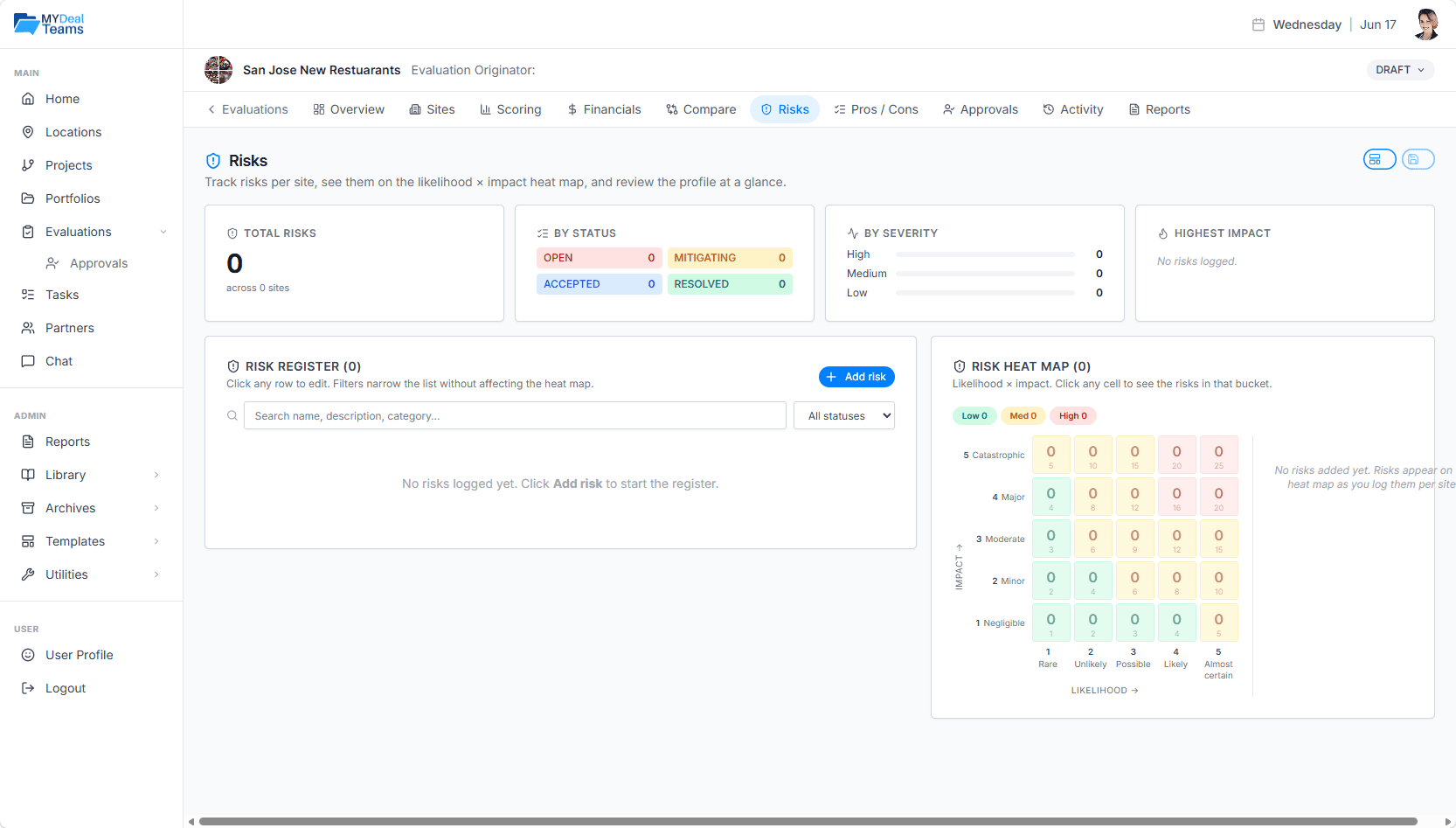
The heat map shows the shape of the risk
A list of risks tells you how many there are. It does not tell you which ones should keep you up at night. The likelihood-by-impact heat map does, by placing every risk in a grid so the ones that are both probable and severe stand out from the ones that are unlikely or survivable.
This is the difference between counting risks and weighing them. Ten low-impact items and one high-likelihood, high-impact item are not the same risk profile, even though a simple count would treat them as ten versus one. Seeing the distribution is what lets a committee spend its attention where the real exposure is.
Accepted is a decision, not a gap
The most useful status in the register is the least obvious one. Accepted does not mean a risk was ignored. It means the team looked at it, decided the deal was worth carrying it, and put that decision on the record with a name attached.
That is what makes a risk register a defensibility tool rather than a compliance checkbox. You are not claiming a site has no downside. You are showing exactly which risks you saw, which you mitigated, and which you consciously chose to accept. A year later, when someone asks whether a problem was foreseen, the honest and documented answer is yes, and here is what we decided to do about it.
MyDealTeams is free during Early Access: Community free, Pro $69/month, everything free while we are in Early Access. Nothing to lose, and a deal team to organize.